


Today, a successful company isn’t just profitable, but also one that manages resources responsibly, because investors and customers are increasingly paying closer attention to your business’s environmental footprint.
We’re used to tracking metrics like margin, operating costs, and staff efficiency, but in the modern world, another critical metric has emerged that’s essential for sustainable growth: the waste diversion rate. Let’s break it down in plain English, how it works in practice, and why it directly affects the financial health of your company.
Table of Contents
Business Waste Diversion
Imagine that your business is like a living organism that consumes resources, uses them, and inevitably generates waste, which is a completely natural process. If in the last century everything was quite simple and linear, you sent whatever you didn’t need to landfill and moved on, today this approach is considered not only outdated, but also costly.
Modern business waste diversion is a thoughtful strategy, the main goal of which is to divert waste from landfill and find a second use for it. This is important because today, materials are too valuable to just bury them in the ground, and savvy leaders know this.
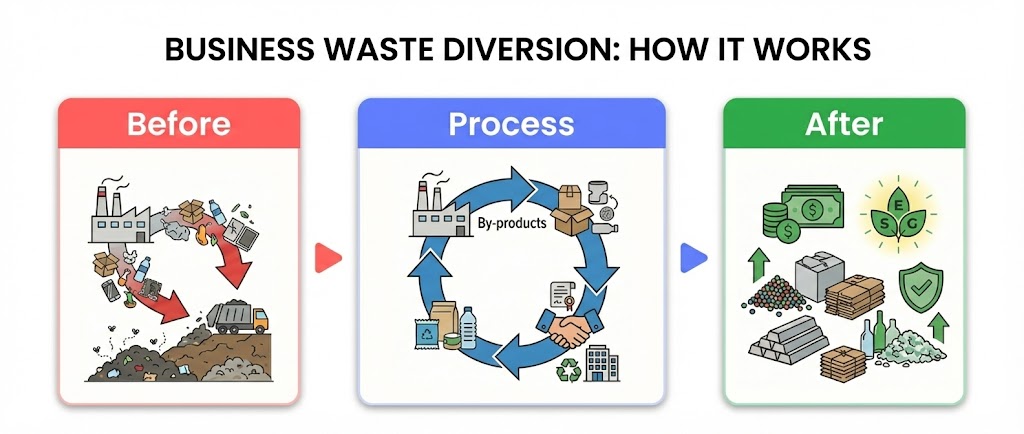
When we talk aboutwaste diversion, we mean designing your supply chain so one process’s by-products become another’s inputs. For example, if you have a garment factory, fabric scraps shouldn’t end up in the bin, but can be sold to partners making furniture upholstery or insulation, which turns disposal costs into revenue.
Many progressive companies are already actively integrating such processes into their ESG solution, and this is done not just for PR or to follow a green trend. This is a strong signal to lenders and investors that your supply chains are built competently, you know how to count money, and your business is resilient to future market challenges.
Diversion Rate
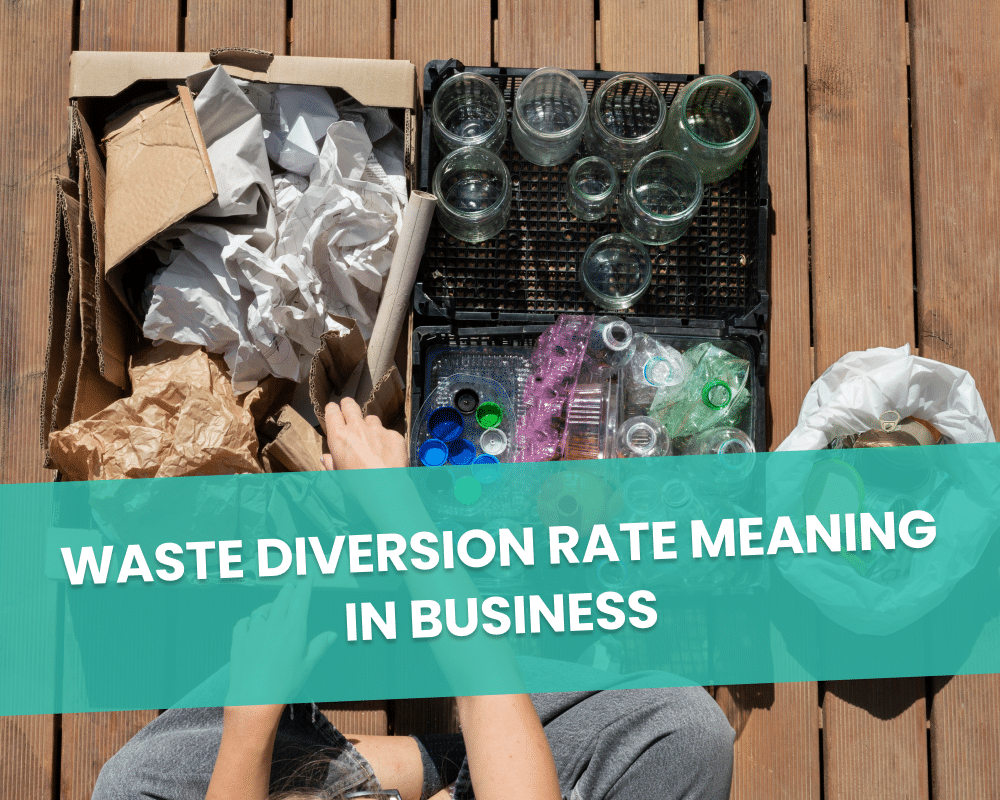
Now let’s move on to the specifics and try to understand what those numbers actually mean. To put it as simply as possible, the diversion rate meaning can be described as an efficiency metric: this is the percentage of waste that you were able to keep out of landfill, compared to the total amount of waste that your company generated over a certain period.
Many entrepreneurs often ask what is waste diversion in real terms and how to understand whether their system is working well. Imagine a situation where your supply chains generate 100 tons of waste per month: if you send 90 tons to landfill, it means that you have serious efficiency problems and you are literally throwing money away. But if out of these 100 tons you were able to recycle 50 tons, send 30 tons to compost, and only 20 tons went to the landfill, this indicates that your supply chain runs like a well-oiled machine.
It is also important to understand the correct terminology: the waste diversion definition covers far more than just sorting into color-coded bins. We are talking aboutlandfill diversion, which includes any methods other than burial or simple incineration without energy recovery. This includes reselling old office equipment, donating furniture to schools, and repairing wooden pallets for reuse in your supply chains, all of this is a plus for you.
Waste Diversion Rate Formula
Enough theory, let’s try to calculate your efficiency, and believe me, you don’t need a math degree to understand the waste diversion rate formula, because it’s straightforward.
Here’s how it looks: (Weight of diverted waste ÷ Total weight of all waste) × 100 = % Diversion Rate
To make this not seem abstract, let’s analyze a real-world example from day-to-day operations. Imagine that over the past month, your office, warehouse, and production (your entire supply chain) have generated a total of 10 tons of various waste.
- You conducted an audit and found out the following facts:
-You successfully handed over 3 tons of paper and cardboard for recycling.
-2 tons of organic waste from the dining room went to the composting station.
-You donated 1 ton of old office furniture to a local nonprofit.
-The remaining 4 tons, unfortunately, went to a municipal landfill. - Now let’s calculate what was saved (diverted): 3 + 2 + 1 = 6 tons.
- Plug the numbers into the formula: (6 ÷ 10) × 100 = 60%.
So, your waste diversion rate is 60%, which is a pretty good start, but remember that ideal supply chains always strive for an indicator close to 100%, often framed as zero-waste.
How to Calculate Waste Diversion Rate
Knowing the formula is good, but how to calculate waste diversion rate as accurately as possible if you don’t have scales at every bin/container?
Here’s a step-by-step action plan to optimize your supply chain:
- Run a waste audit. You need to clearly know what exactly you’re throwing away, so go through the entire chain: from the receiving dock to the office kitchen.
- Accurate measurements. Agree with your waste hauler to provide detailed reports, because today, many haulers have already equipped their garbage trucks with scales and can send you statistics automatically.
- Separate waste streams. You will never be able to accurately calculate efficiency if everything is mixed together, so your supply chain should provide for separate collection of waste at the stage of its generation.
Remember this important nuance: the “Total Weight” must include absolutely everything, both what went to the landfill and what went to recycling or charity. Businesses often make the mistake of not including what they sold as recyclables in the total weight, and this artificially lowers your reported diversion rate.
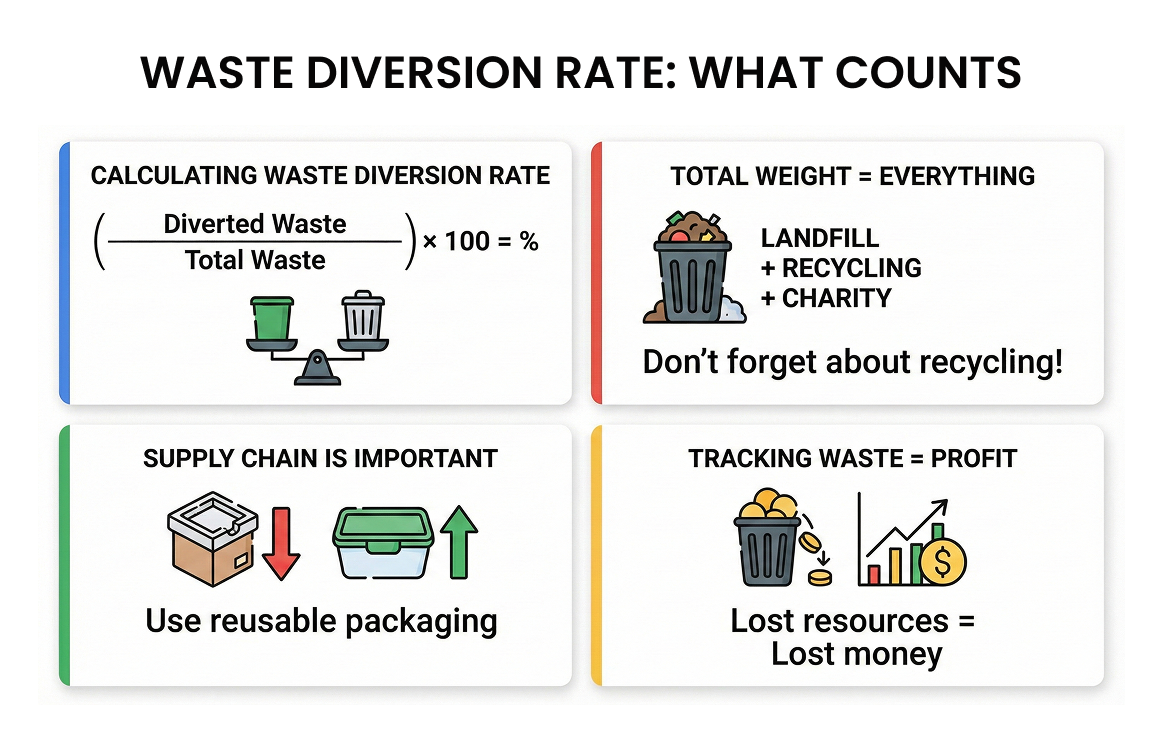
Your supply chains play a key role in this process because they are the main source of waste generation. If you work with a supplier who over-packages every item in three layers of foam, your diversion rate will inevitably drop, because foam is extremely difficult to recycle. A truly sustainable supply chain starts at the negotiation stage, when you require partners to use reusable packaging, so that later you don’t have to rack your brain figuring out where to put the mountain of cardboard.
It is also important for managers to understand the difference in terms, because some people are still confused and do not fully understand what recycling is compared to diversion. Recycling is just one of many tools in your arsenal, while diversion goes beyond recycling and can include reuse (and, in broader programs, waste prevention).
Working to increase this indicator makes your supply chains transparent, and you begin to see a real picture of where you are losing resources. In business, any lost resources are a direct loss, so when you count your waste, you are really counting your efficiency and money.
FAQ
What is The Difference Between the Diversion Rate and the Recycling Rate?
The difference here is significant because the recycling rate only takes into account those materials that have been industrially processed (for example, plastic melted into new pellets). Diversion rate is a much broader concept that includes not only recycling, but also composting, reuse, and any other creative methods that prevent garbage from going to landfill/landfills.
How to Increase the Waste Diversion Rate?
It’s best to start with a full audit of your supply chain to get the real picture. Try to reduce the amount of unnecessary packaging upstream, implement strict waste separation in offices and production, and be sure to look for partners who can take your waste as a valuable raw material for their business.
What can take 1000 years to break down?
Unfortunately, many types of plastic, especially ordinary plastic bags and bottles, can decompose in landfills for up to 1000 years. That is why it is so critical to remove them from the general waste stream in your supply chain and send them to dedicated recycling streams/facilities so as not to leave this “gift” to future generations.
What is Another Word for Waste Diversion?
In professional circles, the terms “landfill diversion” or the broader concept of “waste reduction” are often used, although the latter is more about preventing waste from occurring and is often used alongside diversion, though it’s not the same thing. Also, in the context of supply chain optimization, zero-waste strategies are often mentioned.